Robots, Art, People and Performance Lab
(RAPP Lab)
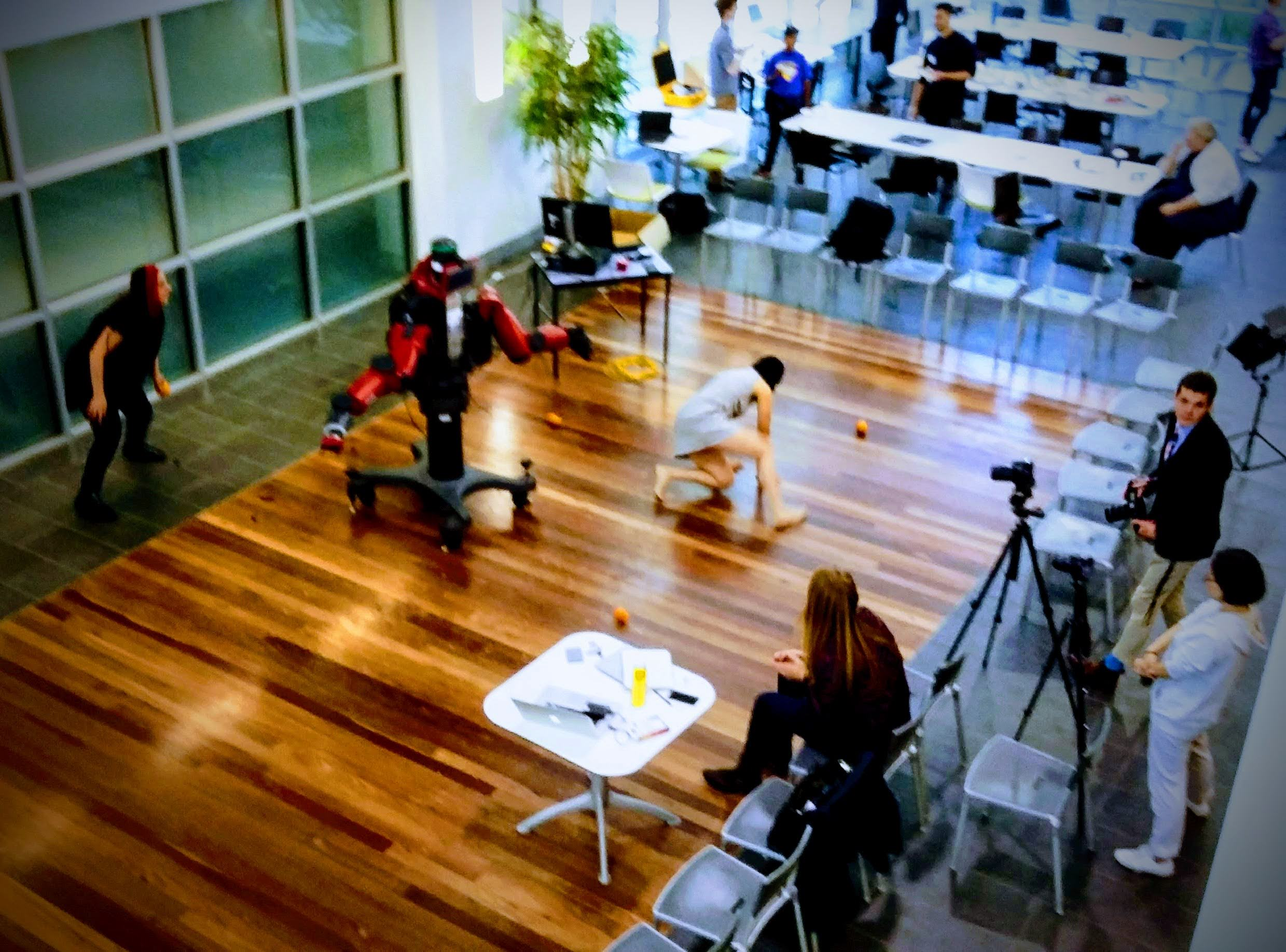
The Robots, Art, People and Performance Laboratory (RAPP Lab) is conceived as a living laboratory that functions as an experimental sandbox where roboticists and artists converge to explore the untapped possibilities of human-robot interaction through the lens of performance. Born from a spirit of curiosity, experimentation and play, this unique collaborative workshop space has evolved over the years with various public and private experimental performances and interactions.
RAPP Lab brings together diverse perspectives from artists, engineers, designers, academics, industry collaborators and the general public to explore and push the boundaries of how robots and humans can interact, create, and perform together. Our approach combines experimental performance methodologies with rigorous technical exploration, creating an environment where artists reimagine robotic movements, roboticists explore new interaction paradigms, and audiences engage with technology in unexpected ways.
By incorporating diverse performance traditions and cultural narratives, from ancient myths to Indigenous choreography to contemporary physical theatre, RAPP Lab examines how robots can transition from mere technological tools to active participants in cultural expression. Through this work, RAPP Lab actively engages with the spectrum of cultural robotics—exploring robots not only as maintainers and participants in human cultural practices but as potential creators of new cultural myths and forms.
RAPP Lab 03 represents the third iteration of this initiative, exploring the dramaturgical potential of human-robot ensembles within devised physical theatre methodologies. Led by theatre practitioner Piumi Wijesundara, roboticist Dr. Maleen Jayasuriya, and Professor Damith Herath, this practice-as-research project examines how Meyerhold’s biomechanics and Lecoq’s Tréteau theatre techniques can serve as entry points for developing ensemble-based storytelling with the UR10 collaborative robot.
Research Focus
The investigation centered on four core research questions:
- How does complicité—the shared, moment-to-moment attunement essential to ensemble work—develop between human performers and a cobot?
- How applicable are Tréteau theatre and Meyerhold’s biomechanics as movement vocabularies for a human-robot ensemble?
- What spectrum of dramaturgical roles can a cobot inhabit—instrument, prop, partner, antagonist, narrator—and how do these roles shape narrative storytelling?
- How can we center underrepresented sociopolitical and cultural narratives in human-robot performance?
Methodology
The practice-as-research framework involved structured workshops with 10 performance artists and roboticists, documented through video, photographs, and participant feedback. The UR10 collaborative robot was selected for its built-in safety features and deliberately non-humanoid form, enabling exploration of diverse dramaturgical roles without anthropomorphic constraints.
Workshop Structure:
- Day 1: Meyerhold’s Biomechanics Block – establishing shared movement vocabulary through mirroring exercises, solo études, and tactile “freedrive” interactions
- Day 2: Lecoq’s Tréteau Theatre Block – exploring spatial constraints and confined physical storytelling within the robot’s operational workspace
Performance Outcomes
The devising process resulted in two original short performances:
- “Unstitched”: A performance critiquing fast-fashion labor ethics, structured around three movement motifs—robot as laborer, consumer, and model—culminating in a deconstruction sequence.
- “Goddess in the Machine”: Reimagining the South Asian myth of Kali’s birth, blending human-robot choreography to explore how the best of intentions can unleash unintended consequences.
Building on the foundations laid by RAPP Lab 01, RAPP Lab 02 extended the Lab’s explorations into the public sphere. Presented during CoLABS, a festival of Art & Science in Sydney, this intervention invited the public to actively participate in the creative process. Participants were encouraged to perform alongside robotic platforms in an immersive and experimental environment, exploring the boundaries between human and machine agency in real time.
This participatory approach highlighted the role of audiences in shaping the future narratives of robotic performance, transforming spectators into co-creators of the experience. The intervention demonstrated the Lab’s commitment to democratic participation and community-led research methods in human-robot interaction.
RAPP Lab 01: Foundational Explorations (2017)
RAPP Lab 01 embodied the ethos of open discovery and collaboration that would define the series. Artists Marian Abboud, a media artist, and Vicki Van Hout, an Indigenous choreographer, partnered with engineers to explore the interplay between movement, robotics, and cultural narratives.
These sessions culminated in an experimental public performance, where robots and humans shared the stage in an improvised, multilayered exchange of gesture and expression. The performance was followed by a discussion panel, providing an opportunity for artists, engineers, and the audience to reflect on the creative, ethical, and technical dimensions of the work.
This first intervention set the tone for RAPP Lab’s mission to foster deep dialogue and experimentation between disciplines and individuals, establishing the framework for future iterations.
Historical Origins
Orpheux Larynx (2011)
The seeds of RAPP Lab were planted in 2011 with artist Erin Gee’s performance Orpheux Larynx, created during her residency at MARCS Auditory Laboratories, Western Sydney University, in collaboration with renowned artist Stelarc. This vocal work for three artificial voices and soprano embodied a radical exploration of human-robot interaction, blending music, technology, and mythology.
Central to the piece was Stelarc’s Prosthetic Head, a computerised conversational agent whose manipulated baritone voice formed the basis of a robotic choir. Drawing inspiration from the myth of Orpheus, the performance reimagined identity and embodiment as fluid and multiplicitous, seamlessly merging past, present, and speculative futures through the shared voices of robotic avatars.
Articulated Head – CLONE (2012)
Another pivotal inspiration was Articulated Head – CLONE 2012, a hybrid virtual-real performance created by Pyewacket Kazyanenko in collaboration with Daniel Mounsey, Ian Upton, and Ze Moo at the Powerhouse Museum. Centered around Stelarc’s Articulated Head, this performance explored the dynamic interplay between physical and virtual worlds, pushing the boundaries of human-robot interaction in performance spaces.
These projects, with their shared emphasis on mythology, embodiment, and the performative potential of robotics, laid the conceptual groundwork for RAPP Lab, inspiring the Lab’s ongoing transdisciplinary exploration of robotic performance, cultural ecologies, and the evolving narratives of human-machine collaboration.
Announcing RAPP LAB 03 (2025)!
Join us for a unique experimental workshop exploring the intersection of Physical theatre and robotics. Through physical theatre methodologies, we will investigate new possibilities in movement and ensemble storytelling with collaborative robotics.
OPEN ARTIST CALL OUT
This free workshop is limited to 10 movement artists. Movement artists from all backgrounds are welcome!
Dates: 15-16th March 2025
Time: 10:00 AM – 5:00 PM
Venue: Collaborative Robotics Lab
University of Canberra
Past events
An Exploratory Study on Human Robot Interaction
The RAPP Lab is a collaboration between the Robotics Lab | Human Centred Technology Centre at the University of Canberra, Aalborg University, Denmark and Robological. In a series of workshops, we explore the aesthetics, ethics, psychology and technologies of humans interacting with robots. Each session includes free-form interactions with robots, an improvised dance performance and a Q&A session with the artists, and an expert panel on robotics, theatre, business and innovation. In collaboration with CoLABS – a festival of Art & Science in Sydney. Workshops are experimental explorations and each session will be unique in experience. The events may be video/photographed for documentation and publicity purposes. Plase, register to attend one of the sessions by following the links bellow. Places are strictly limited to maintain the intimacy of the experience.
RAPP Lab has been conceived and developed by Damith Herath (University of Canberra) and Elizabeth Jochum (Aalborg University, Denmark). Read an article about the project on Canberra Times here.
RAPP Lab Live (Canberra) – At the University of Canberra
The Artists: Marian Abboud (Media Artist) & Vicki Van Hout (Indigenous Choreographer)
The panel includes Prof. Roland Goecke, Dr Elizabeth Jochum, Diane Phillips, Dr Damith Herath
DATE & TIME
Saturday, 23 September 2017 11:00AM (Session 1) 1:00PM (Session 2)
VENUE
Foyer Building 22 & 23 (Retro Cafe)
University of Canberra
University Dr S
Bruce, ACT 2617
RSVP
Free event but booking is essential. This event is part of a Human Robot interaction study, and your image and voice may be recorded for research purposes.
RAPP Lab Live (Sydney) – At CoLABS 2017
Robot Open House
Come meet Baxter and his friends. Discover how robots are learning to work alongside humans. Program a robot to dance…using only your body!
The engineers and artists who are teaching robots to dance will be on-hand to answer your questions. Watch Nao robots perform the latest dance moves, and even program Baxter to perform your original choreography!
DATE & TIME
Saturday, 30 September 2017 11:00AM (Session 1) 1:00PM (Session 2)
VENUE
Bungarribee Park
Corner Doonside Rd & Holbeche Rd,
Arndell Park NSW 2148
TICKETS
This event is co-located with the CoLABS Festival. CoLABS is a ticketed event. This event is part of a Human Robot interaction study, and your image and voice may be recorded for research purposes.