
Stelarc’s
Articulated Head
Upcoming
Currently under development. Please contact us if you are interested in hosting the installation in the future.
The Articulated Head Robotic Art Installation
About
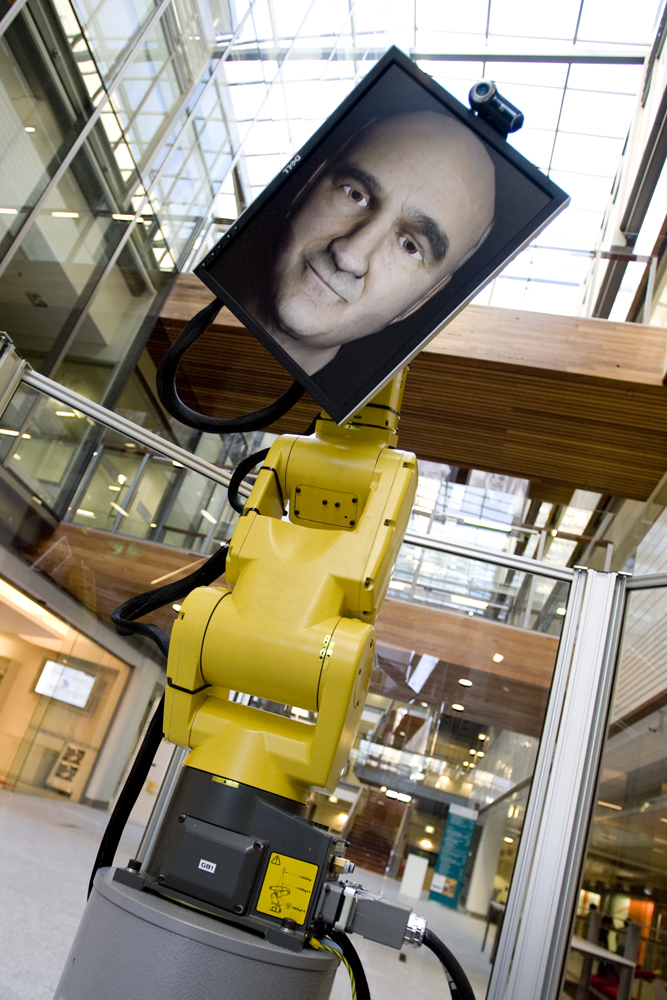
The Articulated Head is a robotic art installation conceived by the celebrated performance artist Stelarc and was initially developed by Damith Herath, Christian Kroos, and Zengzhi Zang at the MARCS Lab (see archived website here). It is designed to explore concepts of agency, awareness, identity, and embodiment. Unlike purely virtual systems, it’s a physical-virtual hybrid featuring an LCD screen displaying an animated head mounted on an industrial robot arm. This setup enables real-time interaction with visitors, with the robot’s movements and the virtual head’s facial expressions synchronised to create the impression of an intentional agent. The Articulated Head uses a sophisticated control system called THAMBS (Thinking Head Attention Model and Behavioural System) to manage its interactions and generate responses, aiming for emergent behaviours rather than pre-scripted movements. The developments of the Articulated Head began in the late 2000s, and various iterations have been exhibited in Australia and internationally. The longest continuous installation was at the Powerhouse Museum in Sydney, spanning 2 years from 2011 to 2012. It continues to evolve, incorporating emerging technologies and remains under development at the University of Canberra’s Collaborative Robotics Lab.

Publications
Key publications
- C. Kroos, D. C. Herath, and Stelarc, “Evoking agency: Attention model and behaviour control in a robotic art installation,” Leonardo, 2011, doi: https://doi.org/10.1162/LEON_a_00435. [PDF]
- C. Kroos, D. C. Herath, and Stelarc, “The Articulated Head: An Intelligent Interactive Agent as an Artistic Installation ” Workshop on Performance Evaluation and Benchmarking for Next Intelligent Robots and Systems at IEEE/RSJ IROS 2009, 15 October 2009.
- D. C. Herath, C. Kroos, C. J. Stevens, L. Cavedon, and P. Premaratne, “Thinking Head: Towards Human Centred Robotics,” in The 11th International Conference on Control, Automation, Robotics and Vision, ICARCV 2010, Singapore, 7-10 December 2010.
- C. Kroos, D. C. Herath, and Stelarc, “The Articulated Head Pays Attention,” in 5th ACM/IEEE International Conference on Human-Robot Interaction, Osaka, March 2-5 2010: ACM/IEEE.
- C. Kroos, D. C. Herath, and Stelarc, “From Robot Arm to Intentional Agent: the Articulated Head,” in Robot Arms, S. Goto Ed.: InTech, 2011, pp. 215-240.
Complete Publication List
By the team
[1] C. Kroos, D. C. Herath, and Stelarc, “The Articulated Head: An Intelligent Interactive Agent as an Artistic Installation ” Workshop on Performance Evaluation and Benchmarking for Next Intelligent Robots and Systems at IEEE/RSJ IROS 2009, 15 October 2009.
[2] D. C. Herath, C. Kroos, C. J. Stevens, L. Cavedon, and P. Premaratne, “Thinking Head: Towards Human Centred Robotics,” in The 11th International Conference on Control, Automation, Robotics and Vision, ICARCV 2010, Singapore, 7-10 December 2010.
[3] D. C. Herath, Z. Zhang, and N. Yadav, “Thinking Head Framework: An open architecture for human centred robotics,” in Information and Automation for Sustainability (ICIAFs), 2010 5th International Conference on, 17-19 Dec. 2010 2010, pp. 527-532.
[4] C. Kroos, D. C. Herath, and Stelarc, “The Articulated Head Pays Attention,” in 5th ACM/IEEE International Conference on Human-Robot Interaction, Osaka, March 2-5 2010: ACM/IEEE.
[5] C. Kroos, D. C. Herath, and Stelarc, “From Robot Arm to Intentional Agent: the Articulated Head,” in Robot Arms, S. Goto Ed.: InTech, 2011, pp. 215-240.
[6] C. Kroos, D. C. Herath, and Stelarc, “Evoking agency: Attention model and behaviour control in a robotic art installation,” Leonardo, 2011, doi: https://doi.org/10.1162/LEON_a_00435.
[7] D. St-Onge, N. Reeves, C. Kroos, M. Hanafi, D. Herath, and Stelarc, “The Floating Head Experiment,” in 6th ACM/IEEE International Conference on Human-Robot Interaction, Lausanne, Switzerland, 2011: ACM/IEEE.
[8] D. C. Herath, C. Kroos, and Stelarc, “Encounters: From talking heads to Swarming Heads,” in Human-Robot Interaction (HRI), 2012 7th ACM/IEEE International Conference on, 5-8 March 2012 2012, pp. 415-415.
[9] D. C. Herath, C. Kroos, C. Stevens, and D. Burnham, “Adopt-a-robot: A story of attachment (Or the lack thereof),” in 2013 8th ACM/IEEE International Conference on Human-Robot Interaction (HRI), 3-6 March 2013 2013, pp. 135-136, doi: 10.1109/HRI.2013.6483538.
[10] C. Kroos and D. C. Herath, “We, Robots: Correlated Behaviour as Observed by Humans,” in Social Robotics: 6th International Conference, ICSR 2014, Sydney, NSW, Australia, October 27-29, 2014. Proceedings, M. Beetz, B. Johnston, and M.-A. Williams Eds. Cham: Springer International Publishing, 2014, pp. 229-238.
[11] L. Cavedon et al., ““C׳Mon dude!”: Users adapt their behaviour to a robotic agent with an attention model,” International Journal of Human-Computer Studies, vol. 80, pp. 14-23, 2015/08/01/ 2015, doi: http://dx.doi.org/10.1016/j.ijhcs.2015.02.012.
[12] D. Herath and C. Kroos, “Engineering the Arts,” in Robots and Art: Exploring an Unlikely Symbiosis, D. Herath, C. Kroos, and Stelarc Eds. Singapore: Springer Singapore, 2016, pp. 3-17.
[13] D. Herath, C. Kroos, and Stelarc, Robots and Art: Exploring an Unlikely Symbiosis. Springer, 2016.
[14] C. Kroos and D. Herath, “Being One, Being Many,” in Robots and Art: Exploring an Unlikely Symbiosis, D. Herath, C. Kroos, and Stelarc Eds. Singapore: Springer Singapore, 2016, pp. 191-209.
[15] D. Hinwood, N. Gurung, C. Kroos, and D. Herath, “A Casual Conversation with a Robot (Runner-up, Robot Design Competition – Innovation in Hardware, design and interfaces for Social Robots and HRI),” in The 12th International Conference on Social Robotics (ICSR 2020) Golden, Colarado, 2020: Springer. [Online]. Available: https://sites.psu.edu/icsr2020/awards/. [Online].
Other citations
Erić, Z., Vesnić, S. and Radinković, Ž., 2025. Body Augmented: Interview with Stelarc. Khōrein: Journal for Architecture and Philosophy, 3(1), pp.215-238. [PDF]
Goodall, J., 2011, January. Magnetic encounters and embodied conversations. In Proceedings of the 2011 IEEE International Conference on Robotics and Automation (ICRA 2011). University of Southern Queensland.
Salmon, R.A., 2014. Avatars, Agency and Performance: The Fusion of Science and Technology within the Arts (Doctoral dissertation, University of Western Sydney (Australia)).
Tillman, D.T. and Velonaki, M., 2023. On Display: Robots as Culture. In Cultural Robotics: Social Robots and Their Emergent Cultural Ecologies (pp. 257-274). Cham: Springer International Publishing.
Gurung, N., Grant, J.B. and Hearth, D., 2024. The uncanny effect of speech: The impact of appearance and speaking on impression formation in human–robot interactions. International Journal of Social Robotics, 16(6), pp.1265-1280.
Jeon, M., Fiebrink, R., Edmonds, E.A. and Herath, D., 2019. From rituals to magic: Interactive art and HCI of the past, present, and future. International Journal of Human-Computer Studies, 131, pp.108-119.
Salmon, R. and Paine, G., 2013, February. Embodiment: auditory visual enhancement of interactive environments. In Proceedings of the 7th International Conference on Tangible, Embedded and Embodied Interaction (pp. 129-136).
Aceti, L., 2010. Inverse embodiment: an interview with Stelarc. Leonardo Electronic Almanac, 17(1).
Gurung, N., Grant, J.B. and Herath, D., 2021, August. What’s in a face? The effect of faces in human robot interaction. In 2021 30th IEEE International conference on robot & human interactive communication (RO-MAN) (pp. 1024-1030). IEEE.
Turnbull, D. and Connell, M., 2014. Curating digital public art. In Interactive experience in the digital age: evaluating new art practice (pp. 221-241). Cham: Springer International Publishing.
Chang, F. and Herath, D., 2025, March. From Interaction to Relationship: The Role of Memory, Learning, and Emotional Intelligence in AI-Embodied Human Engagement. In 2025 20th ACM/IEEE International Conference on Human-Robot Interaction (HRI) (pp. 1269-1273). IEEE.
Gurung, N., Herath, D. and Grant, J.B., 2021, March. Feeling safe: A study on trust with an interactive robotic art installation. In Companion of the 2021 ACM/IEEE international conference on human-robot interaction (pp. 447-451).
Tillman, D.T., 2023. Culture and Technology: Curating New Media in Collaborative Ways. In Cultural Robotics: Social Robots and Their Emergent Cultural Ecologies (pp. 179-187). Cham: Springer International Publishing.
Jochum, P.E.A. and Abramović, B., 2019. The Non-Human Turn in Performance Art: Conversations.
Komorowski, B., | Honorowy Patronat Prezydenta Rzeczypospolitej Polskiej Bronisława Komorowskiego| Honorary Patronage of the President of the Republic of Poland.
Tenti, G., 2025. Performance Art in the Age of Extinction. Philosophies, 10(1), p.13.
Torre, G., 2017. Expectations versus reality of artificial intelligence: using art to examine ontological issues. Leonardo, 50(1), pp.31-35.